|
Video-Welding 4130
CrMoly |
|
Math Used to Generate 4130
Information. |
The Information Below;
 | Provides the math equations that estimate
the theoretical
cooling rates for TIG welds in thin wall 4130 tubes. |
| The cooling rate equations were obtained from the Welding Handbook,
Volume 1, 9th Edition, page 100. |
| Both thick and thin plate equations were developed by Professor C.A.
Adams et al.
|
|
| The data is presented in a way so one can see the numbers
from each part of the equation. As the thickness was increased so was the
heat input. A TIG process efficiency of 0.5 (50%) was used which is
somewhat
higher than the sited Welding Handbook reference but errors on the side of
predicting a slower cooling rate. The thin plate equation is for two
dimensional heat flow and may be OK for a butt weld but a Tee fillet weld
will have faster cooling rate. Therefore despite trying to error on the side
of predicting slower cooling rates, they are all around the 1/4 in Jominy
bar location. The exact cooling rate will be somewhat dependent on the diameter of
the tube as well. However I would expect that perhaps 1/2 way around the
joint the cooling rate would be similar to that predicted. As the complete
circular weld is made the last part will have a preheat from the weld start.
However if a brittle structure is formed in any area and a crack forms, that
is sufficient to be a problem. |
Equation Elements and Values
|
Rc = Cooling rate
at weld centerline; deg F/min |
|
k = Thermal Conductivity of
metal; BTU/min in deg F |
|
p = Density of metal; lb/in3 |
|
C = Specific Heat of metal;
BTU/ (lb deg F) |
|
h = thickness of metal; in |
|
Hnet = Net heat
input; BTU/in [V*I / ipm*.057*process efficiency] |
|
Tc = Temperature
which cooling rate is calculated; deg F |
|
To = Initial
plate temperature; deg F |
Welding Cooling Equations from
page 100 Welding Handbook Volume 1, 9th Edition |
| Thick Plate Equation =Rc =-[2*3.1416*k(Tc-To)2]
/ Hnet |
| Thin Plate Equation = Rc =
2*3.1416*kpC (h/Hnet)2(Tc-To)3 |
|
Calculate estimated cooling
rate @ 1100 deg F for thin wall 4130 tube welds:
Tube = .040 in wall; V (volts)
= 10; I (amps) = 70; travel = 12 ipm
Using thin plate equation:
| -2*3.1416*0.024*0.29*0.11= -.00481 |
| Hnet = 1.66 |
| (h/Hnet)2 = 0.000579 |
| (Tc-To)3 = 1.07*109 |
| Rc = -2981 deg F / min = - 50 deg F / sec |
|
| Tube = .0625 in wall; V (volts) = 10; I
(amps) = 90; travel = 11 ipm
Using thin plate equation:
| -2*3.1416*0.024*0.29*0.11= -.00481 |
| Hnet = 2.33 |
| (h/Hnet)2 = 0.000718 |
| (Tc-To)3 = 1.07*109 |
| Rc = -3700 deg F / min = - 62 deg F / sec |
|
| Tube = .093 in wall; V (volts) = 10; I
(amps) = 110; travel = 9 ipm
Using thin plate equation:
| -2*3.1416*0.024*0.29*0.11= -.00481 |
| Hnet = 3.48 |
| (h/Hnet)2 = 0.000713 |
| (Tc-To)3 = 1.07*109 |
| Rc = -3671 deg F / min = - 61 deg F / sec |
|
REFERENCES USED;
| US Steel Atlas of Isothermal Transformation Diagrams |
| Republic Alloy steels |
| R. A. Grange and Kiefer; "Transformation of Austenite on Continuous
Cooling and Relation to Transformation at Constant Temperature." |
| Walter Crafts and John Lamont; "Hardenability and Steel Selection." |
| AWS Welding Handbook; Volume 1, 9th Addition |
|
|
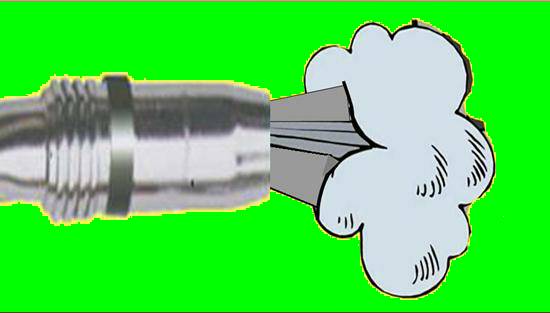 The
"Gas Blast" at MIG Weld Starts Causes Problems: The
"Gas Blast" at MIG Weld Starts Causes Problems:
1)
Shielding Gas Waste
- typically over half the gas used
2) Inferior Weld Quality
- due to air pulled in gas stream
See Patented
Gas Saver System (GSSTM)
Solution That Costs Less Than a Refill.
GSS
Works for TIG Welders with Foot Pedal or Thumb Control
|
| If a Search Engine Found This Page 1st- - - We'd Suggest
a Visit to The Basic Welding 4130 Page; Then Return. Click
Here This page presents the equations that support
the data in the 4130 Technical Details page.
|
|
ONE PAGE SUMMARY
PURCHASE
GSS PRODUCT
FREE Corvette Accessory Installation Info
Check Out Welding
Math Site
|
|
This Page Presents Welding 4130 Math, for
Other Information:
Click for BASIC 4130 WELDING
DETAILS
Click for
TECHNICAL & METALLURGICAL DETAILS
Click for
EQUATIONS
defining weld cooling rate in tubing
Click for
WELDING HEAT TREATED 4130 CHROME MOLY
Click for
METALLURGICAL DEFINITIONS
Click for WELDING A BETTER
STEEL; HY 130 |
 Stop
Wasting Shielding Gas!! Stop
Wasting Shielding Gas!!
See YouTube Videos
Including Our Patented MIG Shielding
"Gas
Saver System" (GSS)
Why MIG Gas Waste
Detailed Review of GSS
Short Overview of GSS-90 Seconds
What User Say About
GSS
Welding Race Cars
Rat Rods-Then and Now
Welding: Go Green
Engineering A
Pro Street / Street Rod
|

"WARNING: "Weld
Safely"
|